
The Great Simplification: Living in the Sitcom Ending
We are mentally living in a sitcom.

In a sitcom, no matter how chaotic the episode gets, everything returns to normal by the final scene. For the last twenty years, we have treated global instability—spiking gas prices, the 2008 crash, the rise of radical populism—as isolated, temporary glitches. We tell ourselves that once we fix the politics or tweak the interest rates, we will go back to the world of 1995.
But there is no normal to return to. We are not in a temporary crisis; we are in a permanent energy descent.
The Red Queen and the Net Energy Cliff
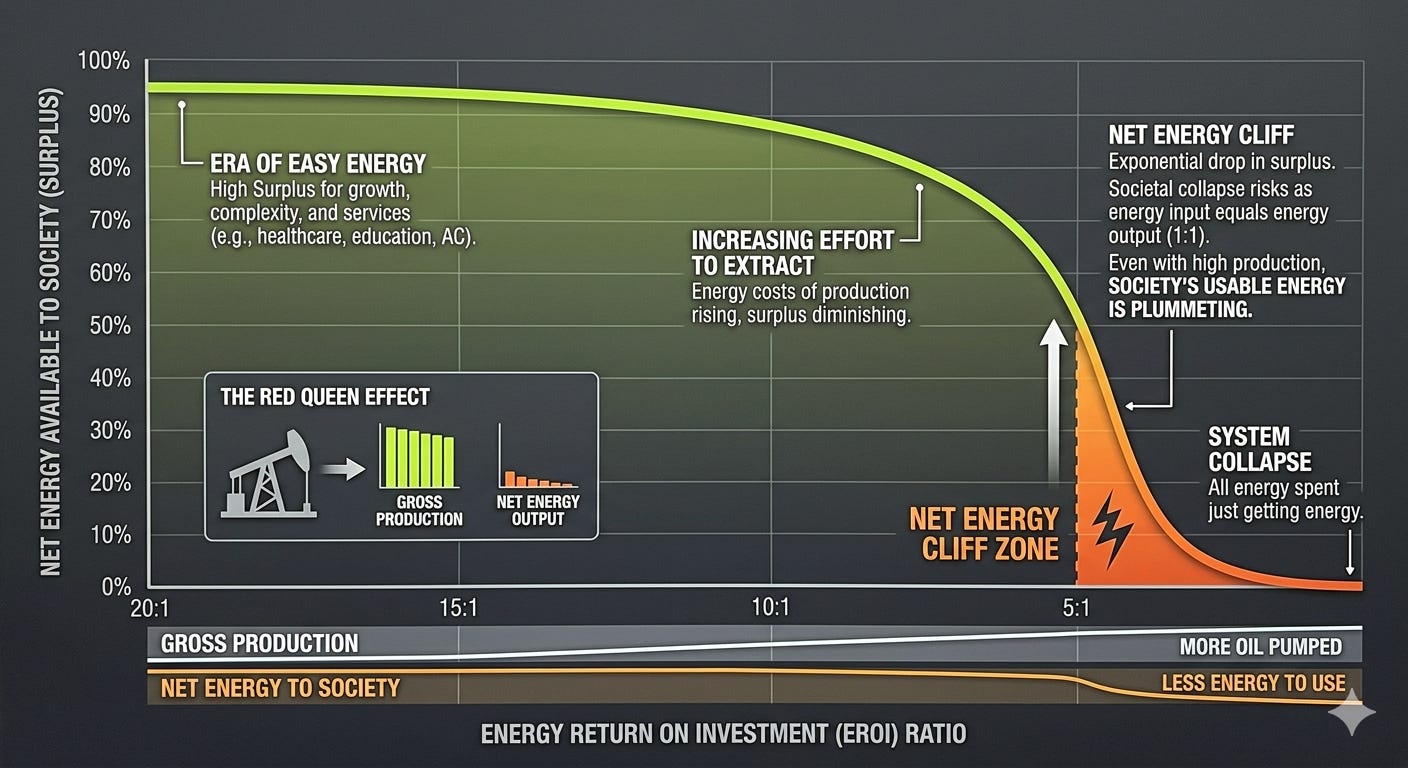
The reason most people are blindsided is that they only look at gross production. They see that tankers are full and oil production is hitting record highs, so they assume the Peak Oil warnings of twenty years ago were a false alarm.
They are missing the Red Queen Effect. We are running faster and faster just to stay in the same place.
In the world of energy, the only metric that matters is Energy Return on Investment (EROI). This is the ratio of energy we get out compared to the energy we have to spend to get it. When we first started pumping oil, the EROI was massive—maybe 100:1. Today, we are scraping the bottom of the barrel with difficult, unconventional resources that require immense energy just to extract.
As our societal EROI drops toward the net energy cliff, the point where it takes nearly as much energy to find oil as the oil itself provides, the surplus energy available to run the rest of civilization begins to evaporate.
The Vulnerability of Wealth
Americans are uniquely unprepared for this reckoning. We have built our lives on the assumption of infinite energy surplus.
I see it in my own family in Alabama. People leave the air conditioning running at full blast all day in an empty house. They drive five-ton metal boxes to get a gallon of milk. They buy new cars every five years. This unbelievable scale of waste isn’t just an environmental problem; it is a massive structural vulnerability.
When the energy budget shrinks, the wealthiest, most complex societies are the ones hit hardest. We have the most complexity to maintain and the fewest ancestral skills left to fall back on. Money and wealth won’t protect a society that has forgotten how to live at a human scale.
Sticking the Landing
We are already twenty years into this transition, and we are not sticking the landing. The fact that basic urban common sense, like the 15-Minute City, is being met with paranoid pushback shows how far we are from internalizing the scale of the problem.
People are focusing on the symptoms: the right-wing turn in politics, the bizarre shifts in NATO, the sudden spikes in the cost of living. They treat these as unrelated events. In reality, they are the tremors of a civilization losing its energy base.
If we want to avoid a Mad Max outcome, we have to stop waiting for a return to normal. We have to wake up to the thermodynamic reality and start building the local, cellular structures that can survive on a fraction of the energy we use today. This isn’t about “saving the planet” in an abstract sense; it is about human survival.
Evidence Log
The Net Energy Cliff: Global EROI decreased at an annual rate of 1.6% between 1995 and 2020. Research indicates that when EROI falls below 10:1, society must reinvest so much energy into extraction that the rest of the economy begins to starve.
The Awareness Gap: Studies on “Energy Literacy” show that while the public is concerned about gas prices, less than 10% understand the concept of Net Energy, leading to a focus on symptoms rather than causes.
Peak Oil 2005-2008: Conventional crude oil production peaked around 2005. The growth since then has come from low-EROI “unconventional” sources like fracking and tar sands, which have much shorter lifespans and higher costs.
Institutional Preparedness: While mainstream media ignores the descent, military organizations like the Pentagon have published studies on energy security that explicitly plan for a world of “supply volatility” and shrinking surpluses.
The Transition Towns Movement: Founded by Rob Hopkins, this movement provides a framework for “Energy Descent Action Plans,” focusing on local food, local energy, and community resilience as the primary defense against systemic collapse.